

The Wheel of Life Explained
Personal and professional development often begins with a simple question:
Where in my life do I want to improve?
Many people feel that something needs to change but struggle to identify exactly what that change should involve.
The Wheel of Life is a widely used coaching framework that helps individuals evaluate different areas of their life and identify where improvement or balance may be needed.
By visualizing satisfaction levels across several life domains, the Wheel of Life provides a structured starting point for reflection and goal setting.
What Is the Wheel of Life?
The Wheel of Life is a self-assessment tool that divides life into several important categories.
Common categories include:
- career
- health
- relationships
- personal growth
- finances
- recreation
- contribution
- environment
Each category represents an area that contributes to overall life satisfaction.
Individuals rate their current level of satisfaction in each area, usually on a scale from 1 to 10.
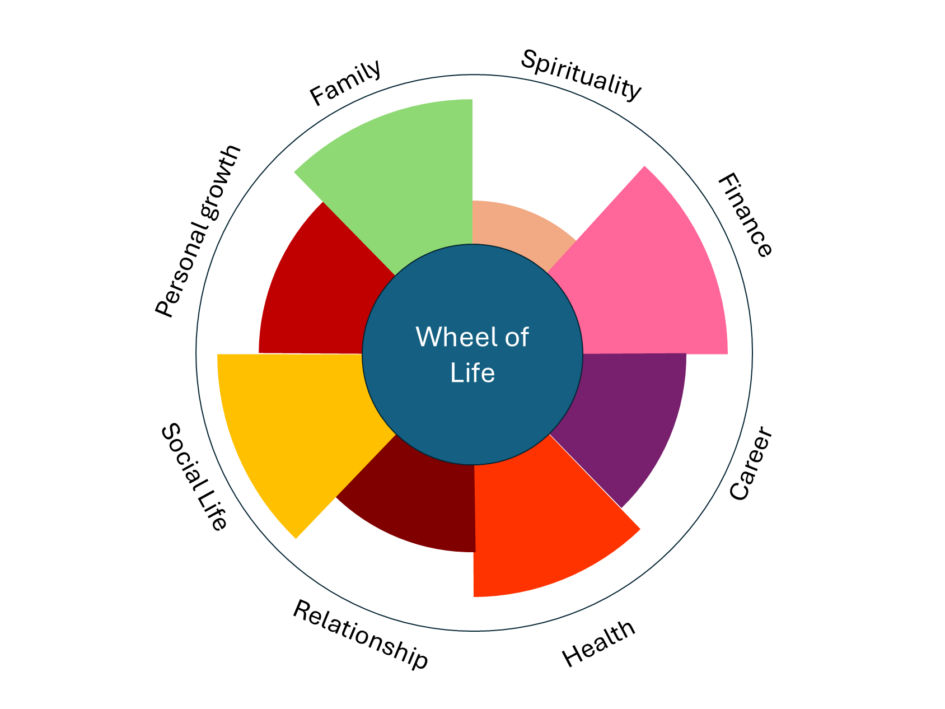
The scores are then plotted on a circular diagram resembling a wheel.
This visual representation quickly reveals where imbalance exists.
Why Balance Matters
Many professionals focus heavily on one or two life areas while neglecting others.
For example, someone may invest most of their energy in their career while overlooking:
- physical health
- personal relationships
- personal development
While temporary focus can be necessary, long-term imbalance often leads to dissatisfaction or burnout.
The Wheel of Life helps individuals see the broader picture and identify areas that deserve more attention.
How the Wheel of Life Works
The exercise typically involves four steps.
- Step 1: Define Life Areas
Select the key areas that represent an important part of your life.
The exact categories may vary depending on personal priorities.
- Step 2: Rate Satisfaction
For each area assign a score between 1 and 10.
A score of 1 indicates very low satisfaction, while 10 represents complete satisfaction.
This evaluation should reflect personal perception rather than external expectations.
- Step 3: Visualize the Wheel
Plot the scores on the wheel.
When the points are connected, the resulting shape reveals the balance of different life areas.
A balanced wheel would appear relatively round.
An uneven wheel indicates areas requiring attention.
- Step 4: Identify Priorities
After visualizing the wheel, individuals identify which areas deserve improvement.
Instead of trying to change everything at once, it is usually more effective to focus on one or two areas first.
The Wheel of Life and Career Development
Although the Wheel of Life covers multiple life domains, it is particularly valuable for career reflection.
Professionals sometimes assume that dissatisfaction at work is caused purely by the job itself.
However the real cause may lie in other areas such as:
- lack of rest
- insufficient personal development
- limited sense of purpose
By examining the broader context of life, the Wheel of Life helps professionals understand how different areas interact.
From Awareness to Action
The Wheel of Life is primarily a diagnostic tool.
Its value lies in increasing awareness.
Once individuals identify areas that require attention, they can define specific actions that improve those areas.
Examples might include:
- developing new skills
- strengthening relationships
- improving health routines
- redesigning career direction
Conclusion
The Wheel of Life provides a simple yet powerful framework for evaluating life balance and identifying opportunities for improvement.
By visualizing satisfaction across different life areas, individuals gain a clearer understanding of where change is needed.
This awareness becomes the foundation for more intentional personal and professional development.






Add comment